Insight
Service sales are mainly reactive
Problem
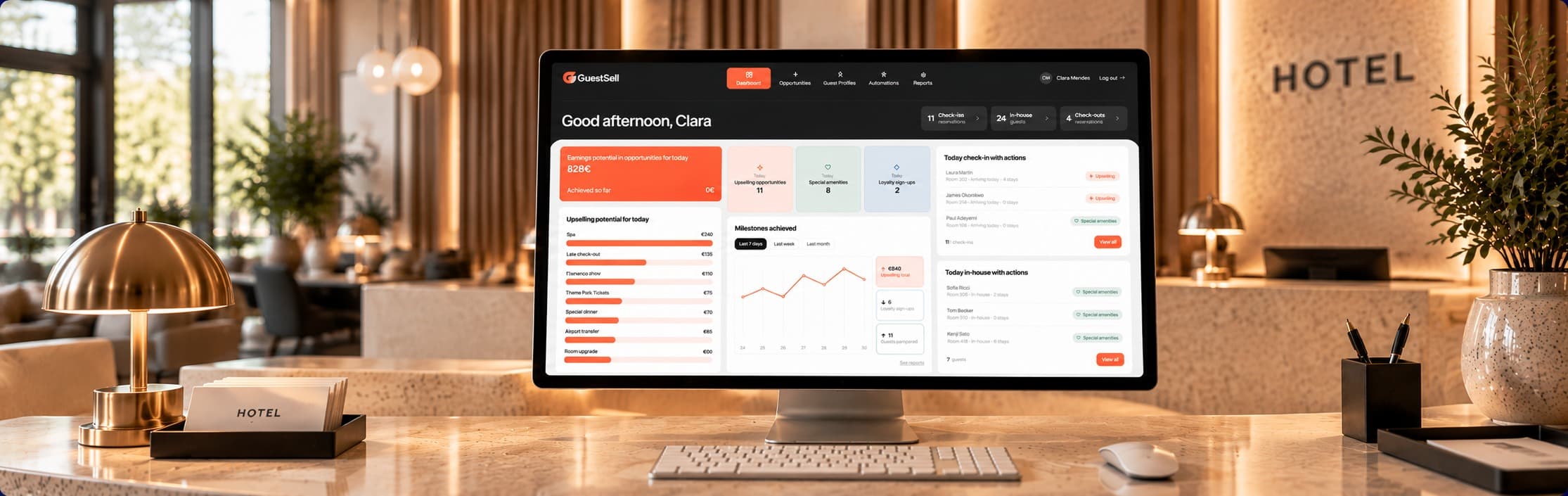
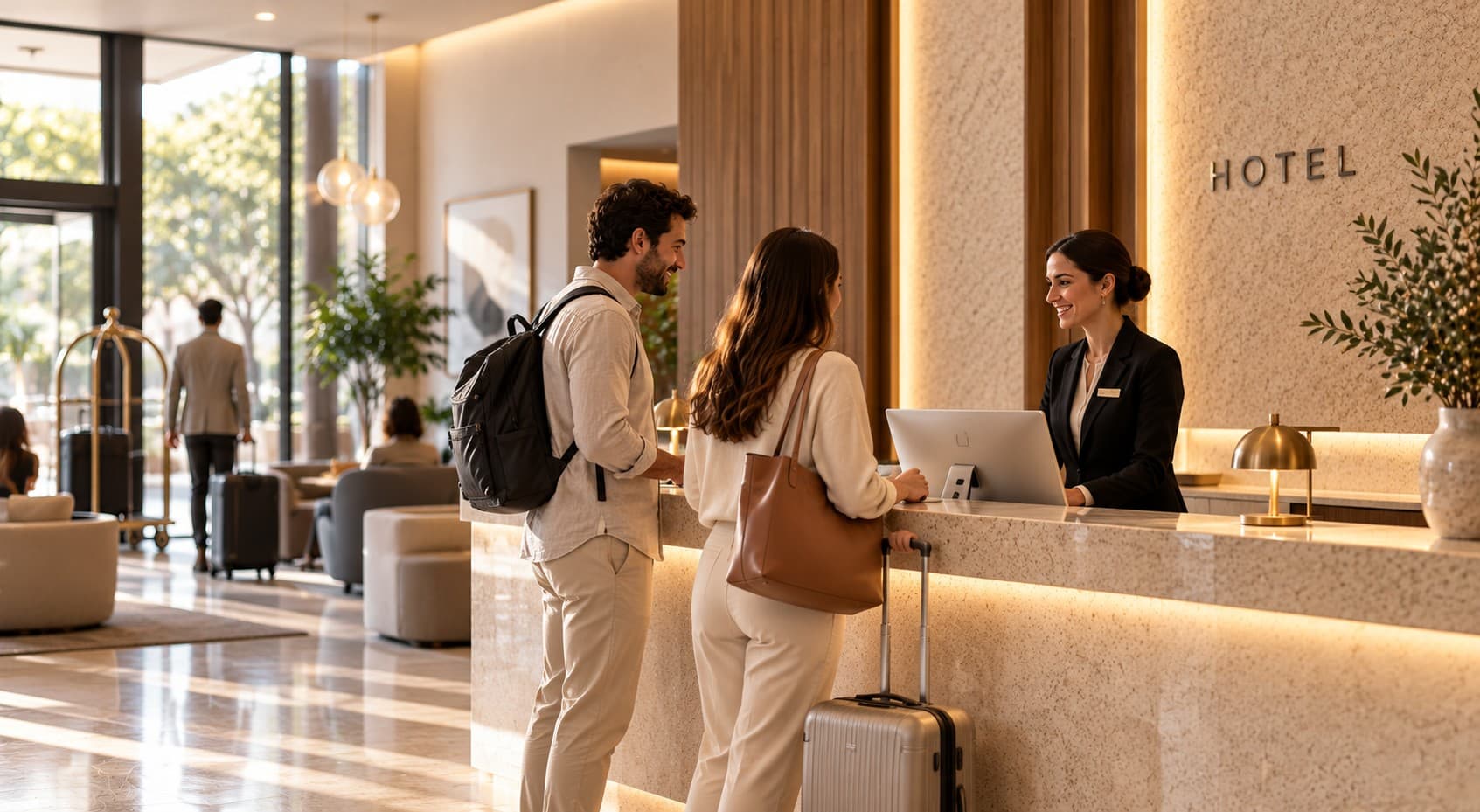
The project starts from a hypothesis based on my experience working at a hotel front desk: direct contact between reception and guests has potential as a sales channel, but opportunities to recommend relevant complementary services are not always seized during the stay.
Without visible prioritization, teams miss chances to offer complementary services that create value for both the guest and the hotel.
Benchmark
Before defining the solution, I analyzed hotel industry tools —CRMs, PMS platforms, and guest experience products— to understand which features are covered today and where gaps remain around selling complementary services from the front desk.
Most solutions already handle guest information, reservation management, segmentation, marketing campaigns, personalized communication (chats), and analytics well. Upselling and cross-selling during the stay, however, appear less consistently, and there is no system that spots the right opportunities for each type of guest and puts them in the hands of the reception team.
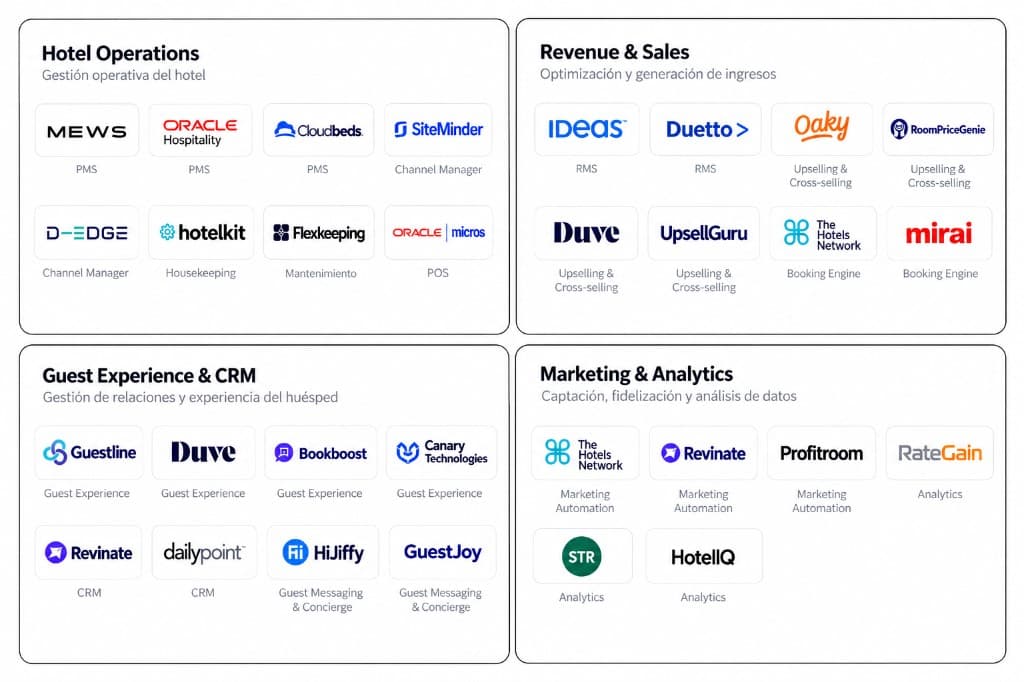
Looking at the closest tools shows a market with similar capabilities in personalization, automation, and in-stay selling. The main differentiation opportunity lies in how those capabilities fit into the front-desk workflow —automatically turning guest data into prioritized opportunities the team can execute and measure.
| Feature | Oaky | Duve | UpsellGuru | GuestSell |
|---|---|---|---|---|
| Personalized upselling | ✓ | ✓ | ✓ | ✓ |
| Automation / segmentation | ✓ | ✓ | ✓ | ✓ |
| In-stay selling | ✓ | ✓ | ✓ | ✓ |
| Front-desk-specific tool | ✓ | ✓ | ✓ | ✓ |
| Detects which guests need a commercial action | ✓ | ◐ | ◐ | ✓ |
| Daily prioritized opportunity queue | ◐ | ◐ | ◐ | ✓ |
| Automation → opportunity → action → result | ◐ | ◐ | ◐ | ✓ |
Research
To test the hypothesis, I interviewed three front-desk professionals at a 4★ vacation resort with about 250 rooms: two receptionists and one manager.
I wanted to understand how they currently spot opportunities to offer complementary services, and what role guest information plays in that process.
Guest needs do not end with the booking. During the stay, new interests appear —activities, dining, wellness, more flexibility, or experiences— that create opportunities to recommend complementary services.
“Often through conversation: families asking about activities, couples mentioning a celebration [...] or people asking for late check-out.”
— Receptionist
There is no systematic process that tells the receptionist which service may be relevant for each guest. Although data and signals exist, it is the employee who has to interpret them and spot the opportunity.
“There are opportunities we spot through experience, but there is no system that suggests them to us.”
— Receptionist
Service recommendations are usually reactive: when the guest asks, requests information, or voices a need. If that interest is not expressed, reception may miss a sales opportunity that could still be relevant.
“Often through conversation: families asking about activities, couples mentioning a celebration [...] or people asking for late check-out.”
— Receptionist
Product strategy
Building on the research insights and the opportunities found in the benchmark, I translated the main problems into product decisions, defining how GuestSell could turn a reactive sales model into a proactive, personalized, and optimized one.
Insight
Service sales are mainly reactive
Product opportunity
Make GuestSell detect opportunities proactively
Insight
Spotting them depends on the receptionist’s experience
Product opportunity
Automate the identification of relevant services
Insight
If the guest does not express interest, the opportunity can be lost
Product opportunity
Use guest data and context to anticipate possible needs
Insight
The catalogue can extend beyond the hotel
Product opportunity
Include own services + external partners
Taking those opportunities as a starting point, I defined three flows that shape GuestSell’s value: centralize guest information, automate opportunity detection, and turn them into clear, measurable actions for the front-desk team.
01
Bring relevant information about each guest into a single profile —preferences, interests, history, and stay context— to enable more personalized service.
02
Use rules and guest data to automatically detect which service may be relevant, for whom, and when —helping reception seize more opportunities during the stay.
03
Turn each opportunity into a clear action for the front-desk team, with result tracking to know which recommendations generate real revenue.
Prototype
GuestSell has also been an opportunity to explore a different way of designing digital products with AI. Instead of finishing every screen in Figma before development, I moved earlier into functional prototypes and direct iteration on the product.
Visual identity definition
Vibe coding exploration
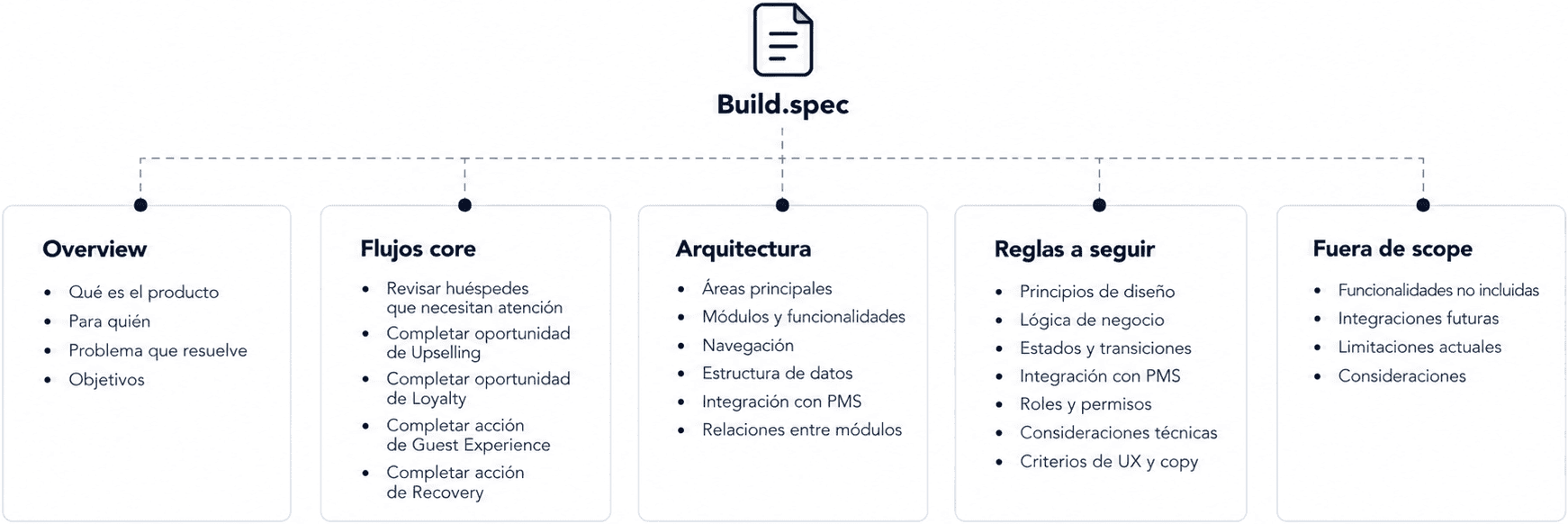
Documentation: build.spec
Deploy
This made it possible to test GuestSell as a connected system, move between different scenarios, and keep iterating on UX, interaction, and implementation in an environment much closer to a real product.
Impact measurement
To check whether GuestSell meets its business goal, I defined a set of metrics that measure both operational adoption of the product and its real impact on complementary service sales.
Number of active automations/services per hotel.
Objective
Measures how far each hotel is configuring GuestSell to generate opportunities. The more relevant services are automated, the greater the product’s potential to fit into operations and generate revenue.
% of worked opportunities that end in a booked service.
Objective
Measures whether opportunities spotted by GuestSell actually turn into sales, and helps analyze which services, automations, and moments work best.
North Star
Additional revenue generated through GuestSell / number of stays.
Objective
This is the main impact metric for the product. It shows whether using GuestSell achieves the business goal: increasing complementary service revenue per guest and stay.